

Deus vult is Latin for "God wills it", also translated "God wants it" or "It is the will of God". It is the cry most closely tied to the First Crusade: medieval chroniclers wrote that the crowd shouted it when Pope Urban II called the knights of Western Europe to arms at the Council of Clermont in November 1095. Today the phrase lives on as a historical motto, a devotional expression, an internet meme and, more controversially, a political slogan.
This deep dive looks at what the phrase means, where it really comes from, how reliable the sources are, its link with the Knights Templar, and why it remains both popular and contested today.
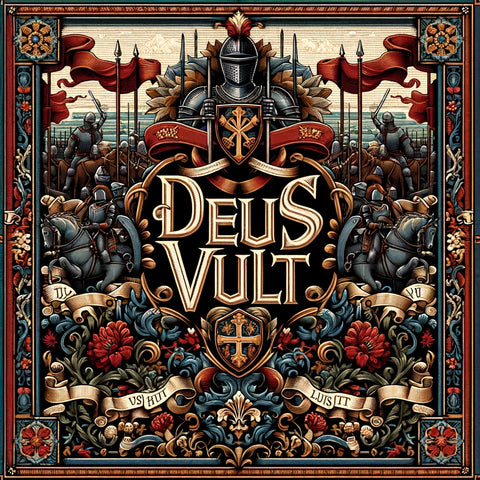
What Does "Deus Vult" Mean?
The grammar is simple. Deus means "God" and vult is the third-person present tense of the Latin verb velle, "to will" or "to want". Together they mean "God wills it" or "God wants it". The phrase expresses the conviction that an action is not a human choice but a duty laid down by God.
Deus vult, Deus lo vult, Deus le volt
Several forms appear in the sources. Classical Latin gives Deus vult. The anonymous Gesta Francorum, written by a crusader in Bohemond's army, records the cry in a vernacular form, Deus le volt. The later form Deus lo vult, mixing Latin and Romance, is the one used today by the Equestrian Order of the Holy Sepulchre of Jerusalem as its motto.
Deus Vult Translation and Pronunciation
How to translate Deus vult
The most accurate English translation is "God wills it". "God wants it" is also correct, because velle covers both willing and wanting. A freer rendering is "It is the will of God". The phrase is a complete sentence: a subject (Deus, God) and a verb (vult, wills), with the object "it" understood. Vult is an irregular form; the same verb gives volo ("I want"), vis ("you want") and volunt ("they want").
Deus vult or vult Deus?
Latin word order is flexible, so vult Deus means exactly the same thing as Deus vult. The form Deus vult, with God first, is the one given in Robert the Monk's account of Clermont and the one that became famous. Do not confuse it with Deo volente, "God willing", a different phrase that expresses hope rather than command.
How to pronounce Deus vult
In Church Latin, as used in Catholic tradition, it sounds roughly like DAY-oos VOOLT. In reconstructed classical Latin, where v was pronounced like an English w, it would be closer to DEH-oos WOOLT. Either is acceptable; the Church Latin pronunciation is the one most people use today.
The Origin: Urban II at Clermont, 1095

On 27 November 1095, at the end of the Council of Clermont in central France, Pope Urban II preached to a large crowd in an open field. Responding to an appeal for help from the Byzantine emperor Alexios I Komnenos, he urged the knights of the West to help the Christians of the East and to free Jerusalem, promising the remission of penance for their sins.
The best-known account of the speech comes from Robert the Monk, who wrote his history of the crusade around 1106–1107. He describes the crowd interrupting the pope with the shout "Deus vult! Deus vult!", and Urban answering that the cry should become the crusaders' battle cry, because God had put it into their mouths.
How reliable is the story?
Historians treat this account with care. No full text of Urban's speech survives. The main versions, by Robert the Monk, Fulcher of Chartres, Baldric of Dol and Guibert of Nogent, were all written after the capture of Jerusalem in 1099, and each author shaped the speech to fit what he knew had happened. Fulcher of Chartres, who was probably present at Clermont, does not mention the cry at all. So we can say that "God wills it" was firmly linked with the First Crusade by the early twelfth century, but not exactly what the crowd shouted in 1095.
Deus Vult During the First Crusade
The Gesta Francorum describes Bohemond of Taranto hearing crusaders cry "Deus le volt!" in southern Italy in 1096, which helped persuade him to take the cross. The cry captured the core idea of the movement: that the expedition was not an ordinary war but a penitential pilgrimage willed by God. That belief helped hold together armies of different languages through the sieges of Nicaea and Antioch and the capture of Jerusalem in July 1099. Read more in The First Crusade (1095–1099).
It is worth remembering what this conviction made possible. The same crusading armies massacred Jewish communities in the Rhineland in 1096 and many inhabitants of Jerusalem in 1099. The phrase belongs to a history that included both devotion and great violence.
Did the Knights Templar Use "Deus Vult"?
The Templars were founded around 1119–1120, two decades after Clermont, so they inherited the crusading ideal that Deus vult expressed. But there is no evidence that it was an official Templar battle cry. The Templar Rule regulates the use of the order's banner, the black-and-white Beauséant, and says nothing about a war cry. The Templars' own visual emblem was the red cross on a white mantle, granted around 1147, which we explain in Templar Cross Meaning and History. The phrase most closely linked with the Templars is a different one, from Psalm 115 (113 in the Latin Vulgate): Non nobis, Domine, non nobis, sed nomini tuo da gloriam, "Not to us, Lord, not to us, but to your name give glory".
The two phrases express related but different ideas. Deus vult is about duty: this is God's will, so we act. Non nobis is about humility: whatever we achieve belongs to God. Read about the second in Non Nobis Domine: the meaning of the Templar motto.
Deus Vult After the Crusades
Military religious orders such as the Hospitallers and the Teutonic Knights carried the crusading idea into later centuries, in the Mediterranean and the Baltic. In the nineteenth century, a Romantic revival of interest in the crusades brought the phrase back into paintings, novels and the ceremonies of chivalric orders. The Equestrian Order of the Holy Sepulchre of Jerusalem, a Catholic order of knighthood under the protection of the Holy See, still uses Deus lo vult as its motto today.
Deus Vult in Modern Culture
Games and memes
Strategy games set in the Middle Ages, such as Paradox Interactive's Crusader Kings series and the Total War games, introduced the phrase to a new audience. From around 2016 "Deus vult" became a popular internet meme, often used ironically, with images of crusader knights.
Political misuse
The phrase has also been adopted by some far-right and anti-Muslim groups, and it appeared on signs at the "Unite the Right" rally in Charlottesville in 2017. Historians who study modern uses of the Middle Ages, such as Andrew Elliott, have shown how medieval slogans can be stripped of their context and turned into political symbols. That does not change the medieval history, but it is why many people now react strongly to the phrase.
Using the phrase today
For Christians, Deus vult can still express a sincere idea: submitting one's life to God's will. For anyone using it, understanding where it came from, and how it has been used since, is the best way to use it with integrity.
Deus Vult at a Glance
- Meaning: "God wills it".
- First linked with: Urban II's preaching of the First Crusade at Clermont, 1095.
- Main source: Robert the Monk's history, c. 1106–1107; the Gesta Francorum records the form Deus le volt.
- Templar motto? No. The Templar phrase is Non nobis, Domine.
- Still used: as the motto Deus lo vult of the Order of the Holy Sepulchre.
From Words to Discipline
For the men who first carried it, "God wills it" was a decision, not a feeling. It meant obedience, kept every day. If you want to bring that kind of structure into your own life, our Templar 7 Days Discipline Hardbook is a seven-day practice built on the Templar idea of a disciplined, ordered day.

Frequently Asked Questions
What does Deus vult mean?
It is Latin for "God wills it" (or "God wants it"). It expressed the belief that the crusade was a duty commanded by God rather than an ordinary war.
Who said Deus vult first?
According to Robert the Monk, the crowd that heard Pope Urban II preach at Clermont in 1095 shouted it, and Urban told the crusaders to use it as their battle cry. Robert wrote about ten years later, and Fulcher of Chartres, who was probably present, does not mention it.
How do you pronounce Deus vult?
In Church Latin it is pronounced roughly DAY-oos VOOLT. In classical Latin the v sounded like a w, so it would be closer to DEH-oos WOOLT.
Is Deus vult the motto of the Knights Templar?
No. It was a general crusading cry used before the Templars existed. The phrase associated with the Templars is Non nobis, Domine, non nobis, sed nomini tuo da gloriam.
What is the difference between Deus vult, Vult Deus and Deus lo vult?
Deus vult and vult Deus are both correct Latin with the same meaning. Deus lo vult is a later mixed Latin-Romance form, used today as the motto of the Equestrian Order of the Holy Sepulchre of Jerusalem.
Why is Deus vult controversial today?
Because some extremist groups have used it as a slogan against Muslims, for example at the 2017 Charlottesville rally. Many Christians and historians still use it in its historical or devotional sense.
Sources and Further Reading
- Robert the Monk, Robert the Monk's History of the First Crusade: Historia Iherosolimitana, trans. Carol Sweetenham (Ashgate, 2005).
- Gesta Francorum et aliorum Hierosolimitanorum, ed. and trans. Rosalind Hill (Nelson, 1962).
- Fulcher of Chartres, A History of the Expedition to Jerusalem, 1095–1127, trans. Frances Rita Ryan, ed. Harold S. Fink (University of Tennessee Press, 1969).
- Jonathan Riley-Smith, The First Crusade and the Idea of Crusading (Athlone, 1986).
- Thomas Asbridge, The First Crusade: A New History (Oxford University Press, 2004).
- Peter Frankopan, The First Crusade: The Call from the East (Bodley Head, 2012).
- Andrew B. R. Elliott, Medievalism, Politics and Mass Media: Appropriating the Middle Ages in the Twenty-First Century (D. S. Brewer, 2017).
Shop the Templar Collection
Wear the crusader cry with pride: hand-picked pieces from the Templar Blog store.

Deus Vult Templar Knight Hoodie
From $49.01

Deus Vult Jerusalem Cross Dad Hat
From $36.23

Deus Vult Embroidered Jerusalem Cross Polo
From $48.31
Browse all Templar apparel → · Browse the full Templar collection
Follow Templar Blog on Facebook for new Templar stories.